The Process of Refoundation (324-330 CE)
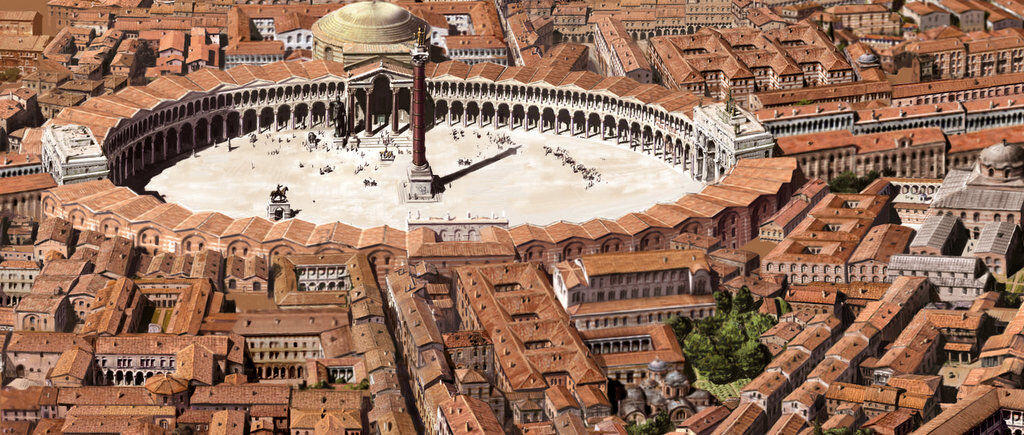
An aerial recreation of the Augusteion. 3D modelling by Albrecht Berger.
Reasons for Selection
Because of Septimius Severus' construction projects, Constantinople was halfway to romanitas. In fact, instead of being a hindrance, the half-finished nature of the city may have made it even more appealing to the emperor Constantine when he looked for a place to establish a new political seat. The city already had projects underway that could transform it into a nova Roma, or new Rome, and Constantine wanted to add more.
The city was still, of course, in a very fortuitous location, much like Diocletian's de facto capital of Nicomedia, but with a more personal touch: it was very near to where Constantine had defeated Licinius, a political rival, just earlier that year.
Something of note about the city of Byzantium is that prior to it becoming the seat of the Byzantine empire, it had no Christian religious significance whatsoever. Constantinople was likely built purely to serve as a political centre and accumulated religious importance by merit of its Christian emperors.
Elements of the Restoration
In 324, Constantine himself took up a spear and walked the limens, or boundary, of the rebuilt city. The walls were to be his first priority. He scooted them west by about 3km (1.8mi), ensuring that the entirety of the Golden Horn fell within the area protected by them. Constantinople was now even more insulated from attack.
The abandoned Severan projects were completed next, with those that had been finished getting a remodel. This area would serve as Constantinople's true urban centre, with the Tetrastoon forum being renamed to the Augusteion (in honour of Augusta Helena, the emperor's mother) taking pride of place. The first new project undertaken by Constantine was the construction of an imperial palace, just behind the hippodrome and mirroring the placement of the palace of Domitian in Rome.
Innovations in Architecture
The architecture of Constantinople exemplified the beginnings of some new, rather un-Roman styles.
| Rome | Constantinople |
|---|---|
| Rectangular shapes | Circular shapes |
| Planar supports | Load-bearing supports |
| Oculi | Arches, sometimes paired with windows |
The favoured architectural style of Rome was a very boxy one, with load-bearing walls that often constrained the amount of open space in walls. It, like many things about Rome, was heavily inspired by ancient Greece, with two significant upgrades that the Byzantine would run with.
Monumental architecture in Rome was constrained by the materials available, and stone and brick limited the design possibilities up until the development of opus caementicium, Roman concrete. Following this, freestanding domes of massive proportions became possible, such as that of the Pantheon, which is still the largest unreinforced concrete dome in the world. From Greece, Rome also took the all-important column, but with the added engineering feat of arches between the tops of columns.
The architectural style of Constantinople took these two things to an extreme. Its monumental architecture shifted away from the square, geometric shapes of Rome's, instead moving towards octa- or decagons and eventually circles. To accommodate for this change, the load-bearing design shifted to load-bearing supports, which enabled walls that were mostly open. Arches and vaults could now be used to support massive domes, lending large buildings a sense of airiness (which turned out to be very popular with Christians).
Spolia
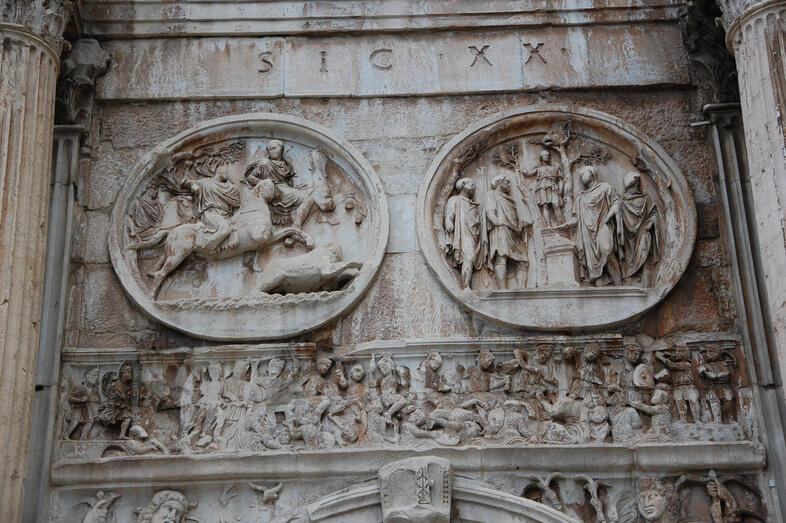
Hadrianic roundels on the southern exposure of the Arch of Constantine. Photo by Steve Kershaw, licensed for noncommercial use under Creative Commons.
It's impossible to talk about the architecture of Constantinople without talking about how much of it was lifted from someplace else- literally. This wasn't a new trick, even for Constantine. The Arch of Constantine (see picture above) in Rome used pieces of monuments belonging to Hadrian, Trajan, and Marcus Aurelius, and the basic design was a redux of Septimius Severus' triumphal arch. In doing so, Constantine likely hoped to confer the greatness of these emperors (three of whom fell within the so-called "Five Good Emperors") onto himself and his own accomplishments.
Throughout the design of Constantinople, remnants of other buildings and monuments can be found, sometimes used with intention, other times not. While the reuse of old stone in new construction was common in Constantinople (see the section on stratified rubble walls), the positioning and choice of some of the spolia, or reused material, indicates that it was being used to convey some ideological concept or tie. According to Eusebius of Caesarea, Constantinople made use of artistic and ceremonial spolia from at least 22 different cities throughout the empire, including Delphi, the Museion at Mt. Helikon, and the Chrysean Temple of Apollo, throughout the city's monumental buildings. The hippodrome in particular almost required foreign monuments; the emperor Augustus had decorated the spina that ran down the centre of the Roman Circus Maximus with one of two obelisks imported from Heliopolis, which was joined by the Lateran obelisk some three hundred years later. (The other obelisk from Heliopolis was used as the dial of Gus' massive outdoor sundial on the Campus Martius.)
The number of repurposed relics in Constantinople suggest a massive effort to select and obtain pieces, one that no other imperial city had required, and the fact that it was done deliberately and over the course of around 20 years, by Sarah Bassett's reckoning, suggests a desire by Constantine (and possibly by his son Constantius as well) to infuse the city with the same sort of prowess spolia had conferred upon Rome.
The architecture of Constantinople, though different from Rome in its techniques, deliberately echoed many of Rome's most well-known design philosophies and practices. The massive influx of spolia, along with the aforementioned spatial relationship between the hippodrome and palace, was the cherry on top of an effort to emphasize Constantinople's prestige, while also serving to align it more closely with the artistic skill and renown of Greece and the glory of the Roman emperors who had preceded him. Through spoliation, Constantinople was implied to be the inheritor of both.
New Building Techniques
As remarkable as the architecture of Constantinople is, when one considers the techniques and materials that were used to make them, they become all the more impressive for the fact that some are still standing. All this is to say: Constantinople was built using a process akin to "trial and error". Some of the results were acceptable, such as the stratified rubble wall, and some were even improvements, like the deep-set foundations. Meanwhile, lime mortar was a gamble that sometimes paid off, but often couldn't be described as anything other than a mistake in slow motion.
Stratified Rubble Walls
In most Roman buildings, the standard way of building walls was with a solid stone core and brick cladding on both sides. Owing to a shortage of construction materials and/or the availability of rubble, it became more commonplace to construct the core of the wall with mortared rubble and encase it with stone, bisected with bands of brick for stability (see picture below, this is a hard concept to put into words). This style worked well when done correctly, but in walls without proper leveling, the outer layers were prone to shearing.


Left: A cross-section diagram of a stratified rubble wall, built with the help of scaffolding. Right: A wall in Rhegion showcasing an alternating brick and stone technique. Both photos from Robert Ousterhout.
Vaulted Bedrock Foundations
Constantinople was not situated on the most level of ground. This necessitated extensively entrenched foundations in many large buildings throughout the city. Some even cut into the bedrock to ensure a level platform. Because of the city's water supply problem (see the section about Constantinople's water supply), these foundations often incorporated cisterns. The Basilica Cistern (see below) is one of the most impressive extant examples of this practice.
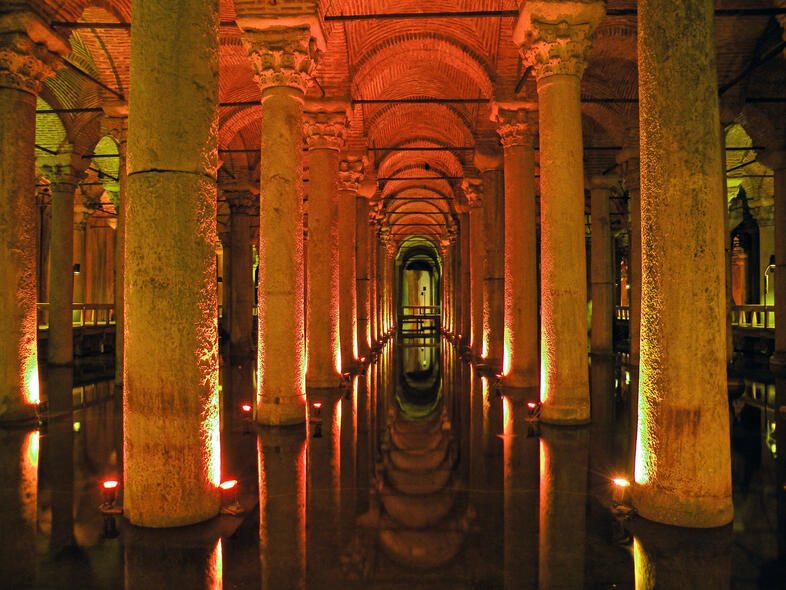
The drained Basilica Cisterns as they appear today. Photo by Moise Nicu, licensed for noncommercial use under Creative Commons.
It may be of interest to note that the Basilica Cisterns also feature examples of spoliation, such as the "sideways Medusa" and "upside down Medusa" column bases. The orientation of these column bases and their use in a non-public location suggests, however, that they were used simply because of their availability as building materials and not because of their artistic or cultural value.
Lime Mortar
Lime mortar is a derivative of Roman concrete that lacks pozzolana, the volcanic sand that gives it a rock-hard consistency. While useful in smaller buildings, this material was particularly ill-suited to larger projects because of how long it took to set. Large quantities of it could take months to fully solidify, which resulted in deformities and unstable buildings, including Justinian's Hagia Sophia (see the section on the Hagia Sophia), part of which collapsed in 557 under uneven pressure from the eastern dome. The most successful and stable lime mortar buildings were often reinforced with wood during construction and for a time afterwards, preventing deformation while the mortar fully set.